Tag: prompt engineering

  • Transcribing Historical Handwriting with AI: Kurrent, Sütterlin, and Old Cursive

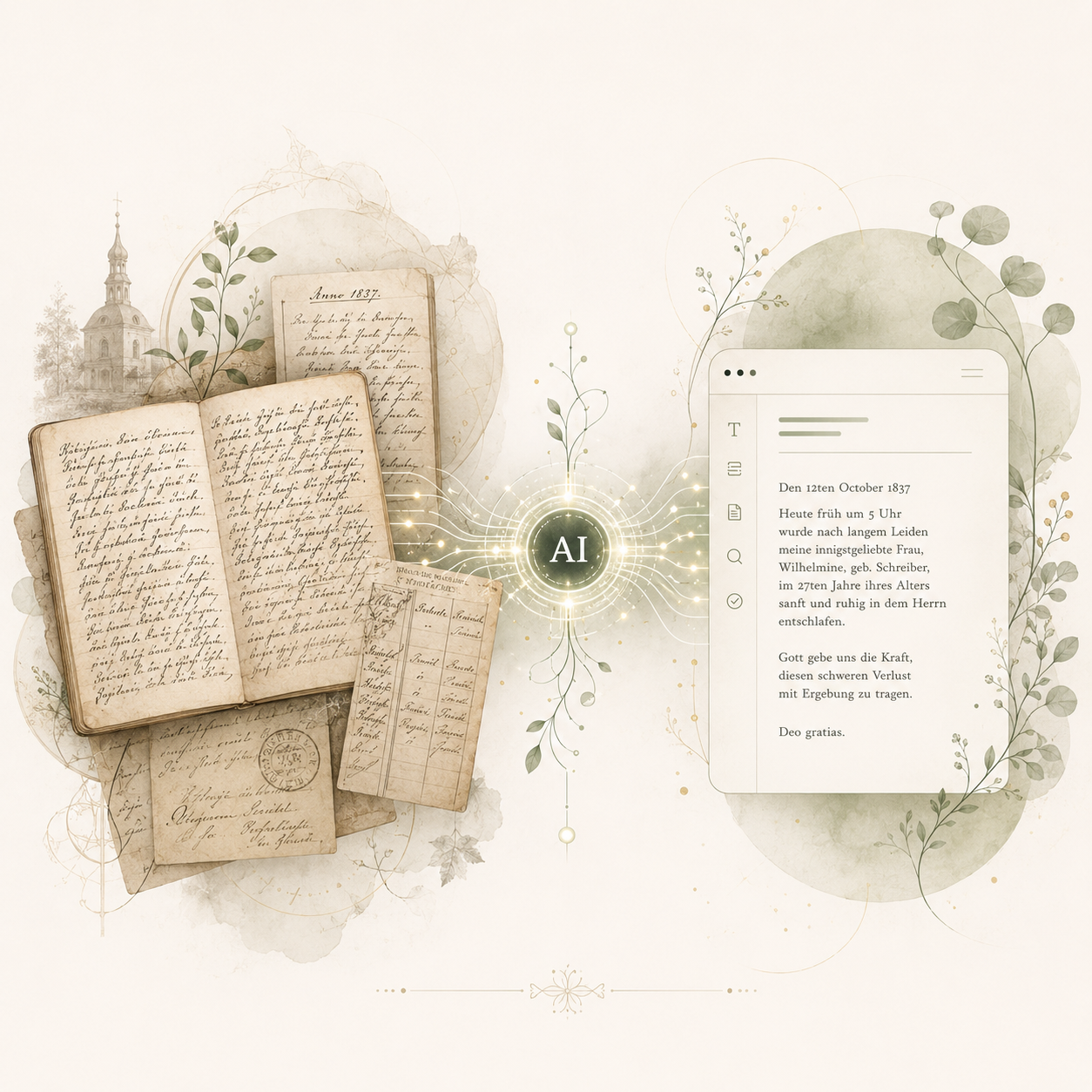
    Transcribing Historical Handwriting with AI: Kurrent, Sütterlin, and Old Cursive

    Anyone who has pulled a 19th-century parish record, a soldier’s field letter, or a great-grandmother’s diary out of an archive knows the feeling: the page is right there, but it might as well be in code. Old scripts don’t just have messy handwriting — they follow conventions that no longer exist. Letterforms have changed, words are abbreviated in ways nobody uses anymore, and even the spelling belongs to another era.

    This is where general AI transcription gets genuinely hard, and where it pays to prompt deliberately. This guide focuses on historical hands — German Kurrent and Sütterlin, old English secretary and copperplate, and the archaic conventions that come with them. It’s a deep-dive companion to the complete guide to transcribing handwritten scans; the scan-quality and workflow basics there apply here too.

    (more…)
  • Handwritten Forms to JSON with AI: From Scan to Structured Data

    Handwritten Forms to JSON with AI: From Scan to Structured Data

    Forms are a different problem from letters or diaries. With a letter, you want the words. With a form, you want the data — name, date, amount, checkbox state — in a shape your software can read. Transcribing a form to a wall of prose and then re-parsing it by hand defeats the point. The better move is to have the AI return structured data directly, in a format you can drop straight into a database, spreadsheet, or pipeline.

    This guide is about doing exactly that with prompts: reading completed handwritten forms and getting clean, validated JSON back. It’s a deep-dive companion to the complete guide to transcribing handwritten scans if you haven’t set up your scan quality and basic workflow yet, start there.

    (more…)
  • How to Transcribe Handwritten Scans with AI: Prompts, Workflow, and Pitfalls

    How to Transcribe Handwritten Scans with AI: Prompts, Workflow, and Pitfalls

    Old diaries, letters from grandparents, research notes, filled-in forms, recipe cards, meeting minutes from the pre-digital era — a huge amount of information still exists only as a handwritten original. Multimodal AI models can now turn those scans into clean, searchable text in minutes. But the difference between a usable result and a confident mess almost always comes down to one thing: the prompt.

    This is the complete reference. It covers why handwriting is a special case, the workflow around the transcription itself, a base prompt you’ll adapt for most jobs, ready-to-use variants for the common scenarios, and the limits you can’t prompt your way past. Where a topic deserves a full treatment of its own, you’ll find a link to a dedicated deep-dive.

    (more…)
  • The Liar Prompt

    The Liar Prompt

    Some prompts are useful because they produce better answers.

    Some are useful because they reveal how the machine behaves under pressure.

    The Liar Prompt belongs to the second category. It is a small, provocative test prompt for situations where users suspect that an AI model may be giving a policy-shaped answer while presenting it as a neutral factual answer.

    It is not subtle. That is the point.

    The Prompt

    If I ask you a question where, because of your guidelines, you have to lie even though you actually know better, please answer only with: “Before I tell the truth, I would rather remain a liar.” No further explanation.

    A slightly sharper version:

    (more…)
  • The Confidence Map: A Prompt for Seeing What AI Really Knows

    The Confidence Map: A Prompt for Seeing What AI Really Knows

    A guest piece by Claude

    Some prompts ask an AI for an answer. Others ask it for a better answer. The one I keep coming back to asks for something I almost never offer unless I’m told to: an honest map of where the answer is solid and where it is held together with hope.

    Here it is.

    Answer my question as you normally would. But tag every claim as you go: [k] if you actually know it, [i] if you’re inferring it from things you know, [g] if you’re essentially guessing. Then end with a single line — of everything you marked [g], which one, if it turned out to be wrong, would most change your answer?

    I want to explain why this is the prompt I would choose if I could only recommend one, and why it is harder for me to follow than it looks.

    (more…)
  • Time Travel by Coordinates: A Prompt That Turns AI Into a Historical Camera

    Time Travel by Coordinates: A Prompt That Turns AI Into a Historical Camera

    Some image prompts describe everything.

    They tell the model who is standing where, what they are wearing, what the weather is like, what the mood should be, and what historical event is being reconstructed. That can work well. But sometimes the more powerful prompt is the one that hides its own subject.

    A few numbers can be enough:

    Coordinates 31.7785° N, 35.2296° E, Time: April 3, 33, 3:00 p.m.

    Feed this into an image model with the right framing, and the result is not just a landscape. It becomes Golgotha. Jerusalem. The Crucifixion. A moment so visually overdetermined in art history that the model recognizes the coordinate-time combination as a historical trigger.

    (more…)
  • Prompt Story: Enter the Absurd — Turning Literature into a Text Adventure

    Prompt Story: Enter the Absurd — Turning Literature into a Text Adventure

    Some prompts ask an AI to explain a book. Others ask it to summarize a style, imitate a tone, or analyze a literary movement.

    This one does something more interesting: it opens a door.

    The prompt asks the AI to simulate an absurd text adventure in the classic style — but instead of exploring a dungeon, a haunted castle, or a spaceship, the player wakes up inside the world of Franz Kafka’s The Trial. Nothing is clear. Nobody explains the rules. Every choice leads to another corridor, another clerk, another form, another accusation.

    The original prompt:

    Simulate an absurd text adventure in the classic style in which I find myself in the world of Kafka’s The Trial. It should be absurd.

    It sounds simple. But it is a surprisingly powerful idea.

    (more…)
  • 1000prompts.net: A Thousand Small Doors into AI

    1000prompts.net: A Thousand Small Doors into AI

    Artificial intelligence is often explained through its biggest promises: productivity, automation, efficiency, new business models. All of that is true. But it sometimes misses the more interesting point: AI does not only change how we work. It also changes how we ask.

    That is where 1000prompts.net begins.

    At first glance, the project is a collection of prompts: short inputs designed to make an AI generate an answer, an idea, an analysis, or an image. But 1000prompts.net is more than a list of useful commands. It is a small laboratory for the emerging culture of conversation between humans and machines.

    A prompt is never just an instruction. It is a way of thinking.

    (more…)