Tag: handwritten scans

  • Transcribing Historical Handwriting with AI: Kurrent, Sütterlin, and Old Cursive

    Transcribing Historical Handwriting with AI: Kurrent, Sütterlin, and Old Cursive

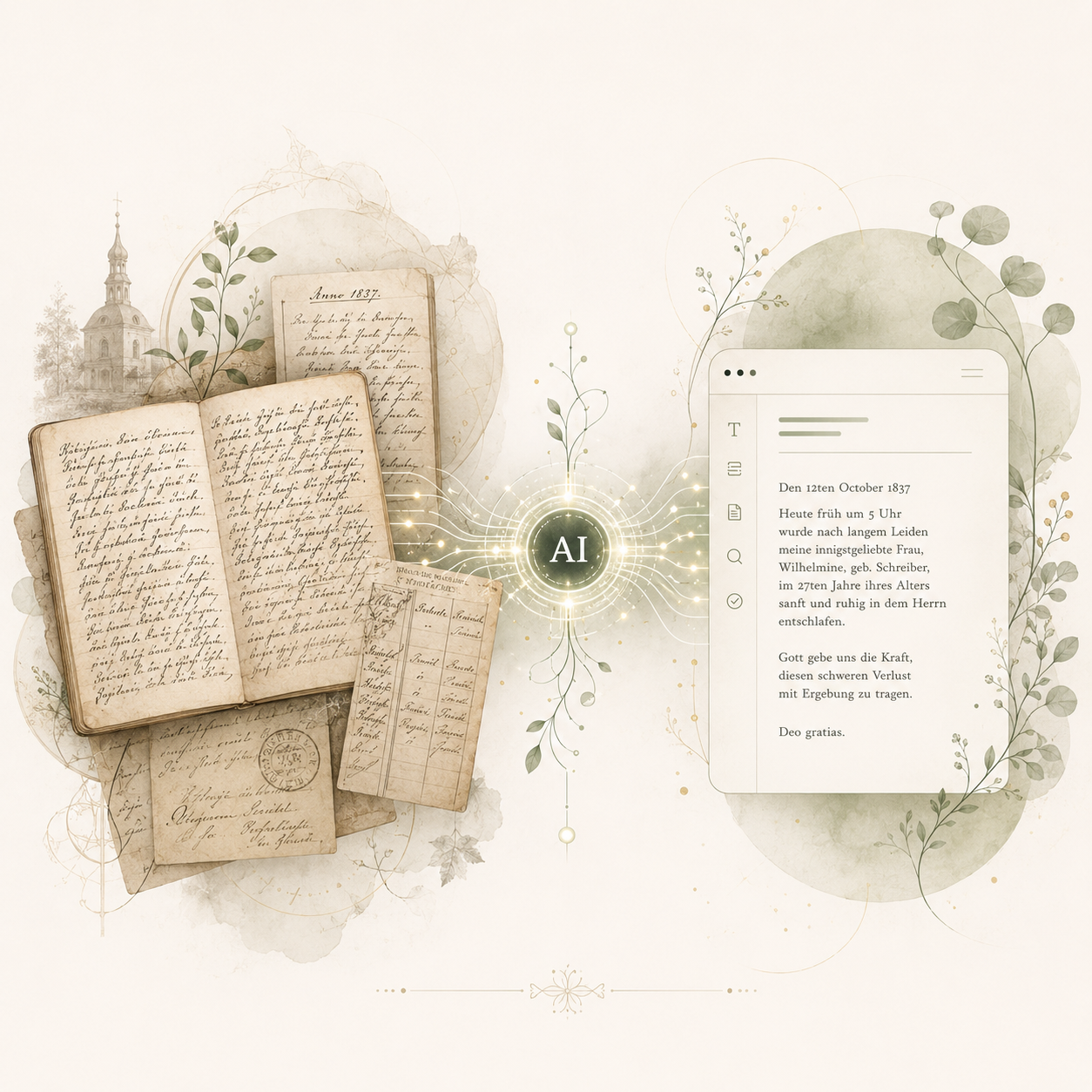
    Anyone who has pulled a 19th-century parish record, a soldier’s field letter, or a great-grandmother’s diary out of an archive knows the feeling: the page is right there, but it might as well be in code. Old scripts don’t just have messy handwriting — they follow conventions that no longer exist. Letterforms have changed, words are abbreviated in ways nobody uses anymore, and even the spelling belongs to another era.

    This is where general AI transcription gets genuinely hard, and where it pays to prompt deliberately. This guide focuses on historical hands — German Kurrent and Sütterlin, old English secretary and copperplate, and the archaic conventions that come with them. It’s a deep-dive companion to the complete guide to transcribing handwritten scans; the scan-quality and workflow basics there apply here too.

    (more…)
  • Handwritten Forms to JSON with AI: From Scan to Structured Data

    Handwritten Forms to JSON with AI: From Scan to Structured Data

    Forms are a different problem from letters or diaries. With a letter, you want the words. With a form, you want the data — name, date, amount, checkbox state — in a shape your software can read. Transcribing a form to a wall of prose and then re-parsing it by hand defeats the point. The better move is to have the AI return structured data directly, in a format you can drop straight into a database, spreadsheet, or pipeline.

    This guide is about doing exactly that with prompts: reading completed handwritten forms and getting clean, validated JSON back. It’s a deep-dive companion to the complete guide to transcribing handwritten scans if you haven’t set up your scan quality and basic workflow yet, start there.

    (more…)
  • How to Transcribe Handwritten Scans with AI: Prompts, Workflow, and Pitfalls

    How to Transcribe Handwritten Scans with AI: Prompts, Workflow, and Pitfalls

    Old diaries, letters from grandparents, research notes, filled-in forms, recipe cards, meeting minutes from the pre-digital era — a huge amount of information still exists only as a handwritten original. Multimodal AI models can now turn those scans into clean, searchable text in minutes. But the difference between a usable result and a confident mess almost always comes down to one thing: the prompt.

    This is the complete reference. It covers why handwriting is a special case, the workflow around the transcription itself, a base prompt you’ll adapt for most jobs, ready-to-use variants for the common scenarios, and the limits you can’t prompt your way past. Where a topic deserves a full treatment of its own, you’ll find a link to a dedicated deep-dive.

    (more…)